
Surface Area of a Cube: Formula, Examples & Easy Guide
Introduction
Have you ever wondered how much cardboard it takes to make a cube-shaped box? Or how much paint you need to coat a square block? The answer lies in understanding the surface area of a cube. This is one of the most practical geometry concepts you will encounter in school and real life.
In this guide, you will learn what a cube is, how to find its surface area using the correct formula, and how to solve problems step by step. Whether you are a student preparing for exams or someone brushing up on math, this article covers everything you need.
What Is a Cube?
A cube is a three-dimensional solid shape where every face is a perfect square. It has 6 faces, 12 edges, and 8 vertices, and all edges are equal in length. Because of this uniformity, the cube is one of the five Platonic solids in geometry.
Some everyday examples of cube-shaped objects include:
- Dice
- Rubik's cubes
- Ice cubes
- Sugar cubes
- Storage boxes
The key feature of a cube is that its length, width, and height are all equal. This one property is what makes its surface area formula so clean and simple.
What Is the Surface Area of a Cube?
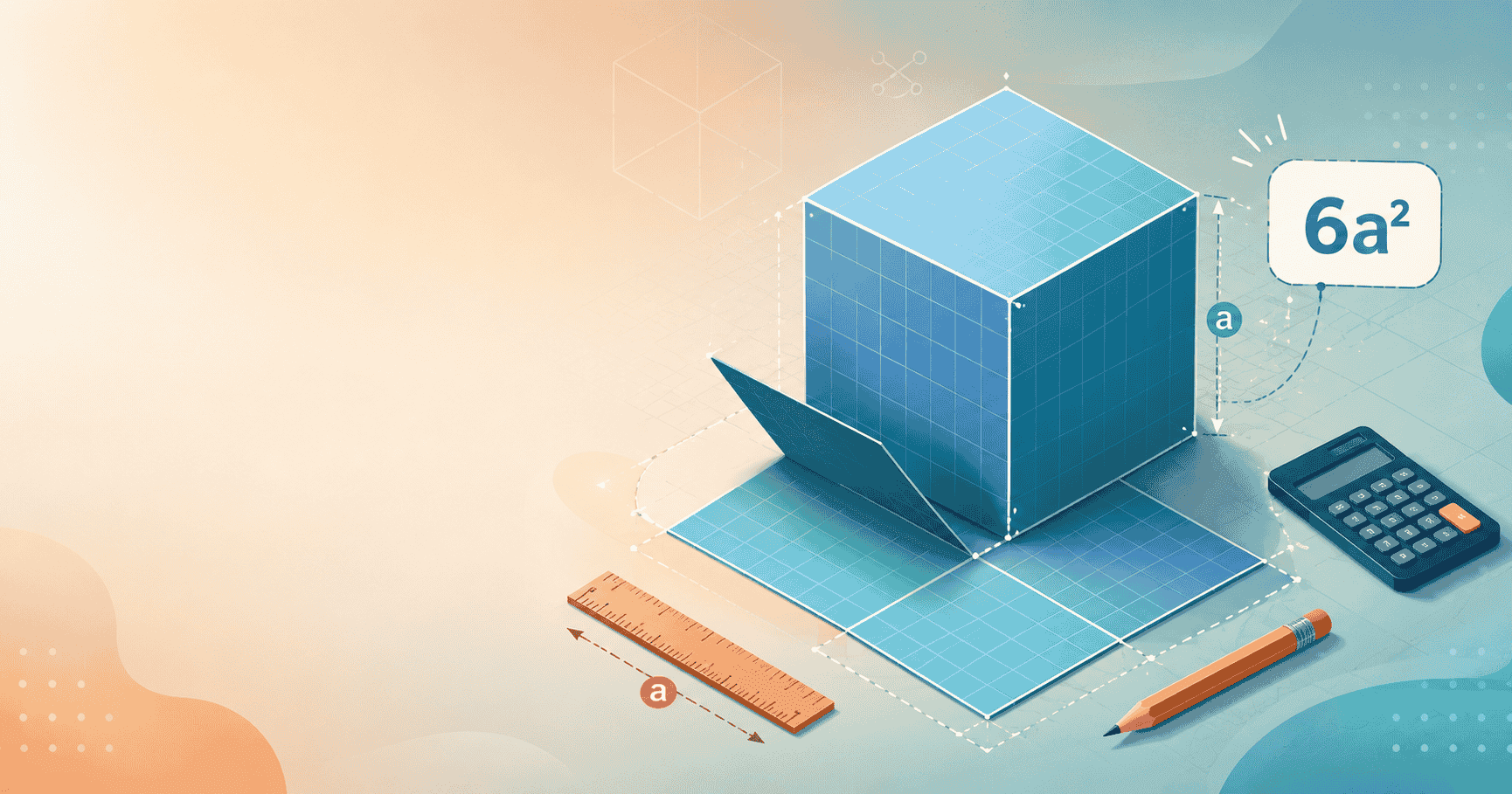
The surface area of a cube is the total area covered by all six square faces of the cube. Think of it as the amount of wrapping paper you would need to completely cover every side of a cube-shaped gift box without any overlaps.
Surface area is always measured in square units such as cm², m², in², or ft².
There are two types of surface area for a cube:
| Type | Faces Included | Formula |
|---|---|---|
| Total Surface Area (TSA) | All 6 faces | SA = 6a² |
| Lateral Surface Area (LSA) | 4 side faces only | LSA = 4a² |
The Total Surface Area includes the top and bottom faces, while the Lateral Surface Area (also called Curved Surface Area or CSA) only counts the four vertical side faces.
Surface Area of a Cube Formula
The formula to calculate the total surface area of a cube is:
SA = 6a²
Where:
- SA = Surface Area of the cube
- a = Length of one edge (or side) of the cube
- a² = Area of one square face
Since a cube has 6 identical square faces, you simply find the area of one face and multiply it by 6.
For Lateral Surface Area:
LSA = 4a²
This formula covers only the four side faces, excluding the top and bottom.
How to Find the Surface Area of a Cube: Quick Guide
Finding the surface area of a cube is a four-step process. Follow these steps every time:
- Step 1: Identify the edge length of the cube (this is your value for "a").
- Step 2: Square the edge length by multiplying it by itself (a × a = a²).
- Step 3: Multiply by 6 to account for all six faces (6 × a²).
- Step 4: Write the answer in square units (cm², m², etc.).
That is all there is to it. The formula is the same regardless of the size of the cube.
Example 1: Find the Surface Area of a Cube with Side 8 cm
Given: Edge length (a) = 8 cm
Step 1: Write the formula.
SA = 6a²
Step 2: Substitute the value and solve.
SA = 6 × (8)²SA = 6 × 64SA = 384 cm²
Answer: The total surface area of the cube is 384 cm².
Example 2: Find the Surface Area of a Cube with Side 5 m
Given: Edge length (a) = 5 m
Step 1: Write the formula.
SA = 6a²
Step 2: Substitute the value and solve.
SA = 6 × (5)²SA = 6 × 25SA = 150 m²
Answer: The total surface area of the cube is 150 m².
Bonus Example: Finding Surface Area from Volume
Sometimes you are given the volume of the cube instead of the side length. In that case, find the edge length first by taking the cube root of the volume.
Example: A cube has a volume of 125 cubic units. Find its surface area.
Step 1: Find the edge length.
Volume = a³ = 125a = ³√125 = 5 units
Step 2: Apply the surface area formula.
SA = 6a² = 6 × (5)² = 6 × 25 = 150 square units
TSA vs LSA: Key Differences at a Glance
| Feature | Total Surface Area (TSA) | Lateral Surface Area (LSA) |
|---|---|---|
| Faces included | All 6 faces | Only 4 side faces |
| Formula | 6a² | 4a² |
| Use case | Painting an entire box | Wrapping only the sides |
| Unit | Square units | Square units |
Understanding when to use TSA versus LSA depends on the problem. If a question asks how much material covers the whole cube, use TSA. If it only asks about the sides (like walls in a room), use LSA.
Real-Life Applications of Cube Surface Area
This concept is not just classroom math. It shows up in many practical situations every day:
- Packaging industry: Calculating how much cardboard is needed to make a box.
- Architecture: Estimating materials required to clad or coat cube-shaped structures.
- Manufacturing: Determining how much paint or coating is needed for a cubic product.
- Science: Studying heat exchange and biology through surface area to volume ratios.
Knowing how to calculate the surface area of a cube saves both time and materials in professional settings.
Common Mistakes to Avoid
Students often lose marks on surface area questions due to simple errors. Watch out for these:
- Using 6 × a instead of 6 × a² (forgetting to square the side).
- Mixing up TSA and LSA formulas.
- Forgetting to include square units in the final answer.
- Using different units for the edge length without converting first.
Always double-check that your edge length values use the same unit before applying the formula. If a careless mistake on a recent test already cost you points, our guide on How to Recover From a Bad Test Score walks you through exactly how to bounce back and avoid repeating the same errors.
Frequently Asked Questions
What is the surface area of a cube?
The surface area of a cube is the total area of all six square faces, calculated using the formula SA = 6a².
What is the formula for the surface area of a cube?
The formula is SA = 6a², where "a" is the length of one edge of the cube.
How many faces does a cube have?
A cube has exactly 6 faces, and all of them are identical squares.
What is the difference between TSA and LSA of a cube?
TSA includes all 6 faces (formula: 6a²), while LSA includes only the 4 side faces (formula: 4a²).
What units are used for surface area of a cube?
Surface area is always expressed in square units such as cm², m², in², or ft².
How do I find the surface area if only the volume is given?
Take the cube root of the volume to get the edge length, then apply SA = 6a².
Can the surface area of a cube ever equal its volume?
Yes, when a = 6 units, the surface area is 216 square units and the volume is 216 cubic units, but they represent different measurements.
Why is the surface area formula 6a² and not just a²?
Because a cube has 6 equal square faces, and each face has an area of a², so you multiply a² by 6 to get the total.
Conclusion
The surface area of a cube is a foundational geometry concept that is both simple to understand and widely applicable. With just one value, the edge length, you can calculate the total surface area using SA = 6a² in four easy steps. Remember to always square the side first, multiply by 6, and include square units in your answer.
Whether you are solving a textbook problem or figuring out how much material you need in a real project, this formula has you covered. Practice a few examples on your own, and you will find this becomes second nature very quickly. Once you have your scores in hand, our free Grade Calculator makes it easy to convert them into percentages and letter grades instantly.
Ready to Grade Your Tests?
Use our free Grade Calculator to instantly convert scores to percentages and letter grades.
Try Grade Calculator